12 May 2025
Property Tax in Singapore
This article contains a brief description of the property tax in Singapore. Contact our accounting firm in Singapore for more details.
The property tax in Singapore, which represents a wealth tax, is regulated by the Property Tax Act on immovable real estate in the City-State. It is due in advance every year and is calculated by applying the appropriate taxation to the Yearly Value of the real estate.
Our accounting firm in Singapore can provide more details on this matter.
Who must pay the property tax in Singapore?
Both Singapore citizens and non-residents who own properties in the City State are subject to the property tax. They can own various types of real estate, including land. With respect to residential homes, it is important to note that they are categorized into:
- properties developed by private contractors;
- Housing & Development Board (HDB) properties;
- government-owned real estate.
The type of property one owns does not impact the property tax paid in Singapore.
| Quick Facts | |
|---|---|
| Possibility to acquire a property in Singapore as a foreign citizen (YES/NO) | Yes, foreign citizens are allowed to buy real estate in Singapore. |
Existence of property tax in Singapore (YES/NO) | Yes. |
Special law available (YES/NO) | Yes, the Property Tax Act. |
| Computation of the property tax formula | Annual value of the property x Property Tax Rate = Property Tax Payable |
| Payment requirements | The levy is paid annually. |
| Authority to pay the tax with | Inland Revenue Authority of Singapore. |
| Special requirements applicable to properties in Singapore | The tax is computed based on a yearly value. |
| Property tax payment requisites for non-residents | Non-residents must also pay the tax for property ownership purposes. |
| Payment due date | 31st of January, as it must be paid in advance. |
| Property tax rates | – for owner-occupied properties, the rates range from 0% to 32%, – for non-occupied properties, the rates range from 12% to 36%. |
| Property tax exemptions (if any) | Tax exemptions apply to properties used by charities. |
| Property tax deductions availability (YES/NO) | Yes, property tax rebates are available for residential properties. |
| Special requirements for commercial property owners (YES/NO) | 10% of the annual value. |
| Other real estate taxes in Singapore (if any) | There are no other taxes. |
| Support in filing property tax documents (YES/NO) | Yes, our accountants in Singapore can assist with the filing of property tax statements. |
| Computation of the tax for owners of more than one property | The owner is taxed at the standard rate for the home he/she lives in, while the other properties will be taxed at the non-occupant rates, even if any of them is used as a second residence. |
Is a property used as a home office subject to the Singapore property tax? | It depends on how it is listed in the income tax return, as the IRAS has a special scheme for residential properties used as home offices. |
Tax rates applicable for houses used for dwelling and commercial purposes | The tax will be applied at the rates specific for each use. |
| Requirement to notify the IRAS about the change of use of a property (YES/NO) | Yes, the owner has the obligation to report such a change to the IRAS. |
| Notification timeframe (if any date applies) | 15 days from the change of use. |
| Are vacant properties subject to taxation? (YES/NO) | Yes. |
| Tax rates applicable to vacant properties | Such properties are taxed at the non-occupant rates. |
| Applicability of late payment fees (YES/NO) | Yes, late payment fees apply to owners who do not respect the deadline. |
| Late payment fee (%) | 5% of the amount due. |
| Possibility to make arrangements in case of late payments (YES/NO) | Yes. |
| Special tax rate applicable for HDB (Housing & Development Board) property (YES/NO) | No special HDB rate: owner-occupier rates (0% on the first SGD 12,000 of Annual Value) apply to all owner-occupied homes, HDB or private. |
| How is the Annual Value determined? | – by size and condition of the property, – the rental value for similar real estate, – an estimated gross rental income per year. |
| Applicability of rental income tax (YES/NO) | Yes, for rented properties, a different tax must be paid by the owner. |
| Computation of the rental tax | The rental tax depends on the annual and rental income obtained by the owner. |
| Are foreign citizens/companies covered by Singapore double tax treaties related to real estate ownership? | Properties are taxed in the country they are built in. |
How is the property tax in Singapore calculated?
The Yearly Value of real estate usually results from an estimation of the yearly rent which could be imposed if the property was rented. It is determined by the Inland Revenue Authority of Singapore (IRAS) which considers the rentals of similar real estate in the nearby location.
No matter whether the property is rented, vacant, or occupied by the owner, the property tax in Singapore is still calculated based on the Yearly Value of the property. It is though important to remember that properties occupied by the owner are due less taxes because they are categorized differently. Vacant and rented pieces of real estate fall under the Non-Owner-Occupied Properties.
The Yearly Value of land in Singapore is set at 5% of the land market price.
The property tax in Singapore can be calculated based on the following formula:
Yearly value x Property Tax Rate = Property Tax Payable
The Yearly Value is calculated by the monthly market rent price of the property multiplied by 12. The market rent is the rent after deducting rentals for furniture and maintenance costs.
Determination of the annual value of a property
One of the components of the property tax in Singapore is the annual value which is calculated by the IRAS based on specific criteria. The most important aspects to consider are that:
- the annual value usually relies on the estimated gross rent that could be obtained per year if the property was leased;
- rental values for similar properties are also considered when determining it;
- the size and the condition of the real estate are also important in the assessment of the IRAS.
Considering the annual value is used for the calculation of the Singapore property tax for both owner-occupied, leased, and vacant properties, it should be noted that the methods of assessment are the same no matter this status.
Our accountants in Singapore can assist with the calculation of the property levy.
Non-Owner-Occupied Property taxation in Singapore
If the real estate is vacant or rented, a progressive tax rate is applied, as stated below:
• the YV for the first SGD 30,000 is 12%;
• the YV for the next SGD 15,000 is 20%;
• if the value of the property is at least SGD 45,000, for this amount, the tax paid is SGD 6,600;
• the YV for the next SGD 15,000 is 28%;
• for properties valued at a minimum of SGD 60,000, the total amount due is SGD 10,800;
• the YV is above SGD 60,000 – a 36% property tax rate applies.
Owner-Occupied Property taxation in Singapore
If the owner actually resides in the real estate, the property tax rate in Singapore is reduced significantly, as follows:
- if the YV is first SGD 12,000 – a 0% property tax rate;
- if the YV is next SGD 28,000 – a 4% property tax rate. An accountant in Singapore can offer more information on what this YV consists of;
- on the next scale for the first SGD 40,000 – the minimum tax paid is SGD 1,120;
- the YV on the following SGD 10,000 – a 6% property tax rate applies;
- the next value is SGD 50,000 for which the minimum tax is set at SGD 1,720;
- the YV on the next SGD 25,000 is 10% property tax rate applies;
- for properties valued at at least SGD 75,000, the amount paid is SGD 4,220;
- for the next SGD 10,000 – a 14% property tax rate applies;
- for properties valued at least SGD 85,000, the minimum amount paid is SGD 5,620;
- for the next SGD 15,000, a rate of 20% is applied;
- for properties valued at a minimum of SGD 100,000, the amount due is SGD 8,620;
- for properties valued at a maximum of SGD 140,000 a total rate of 26% applies;
- for properties above SGD 140,000, the total payable rate is 32%.
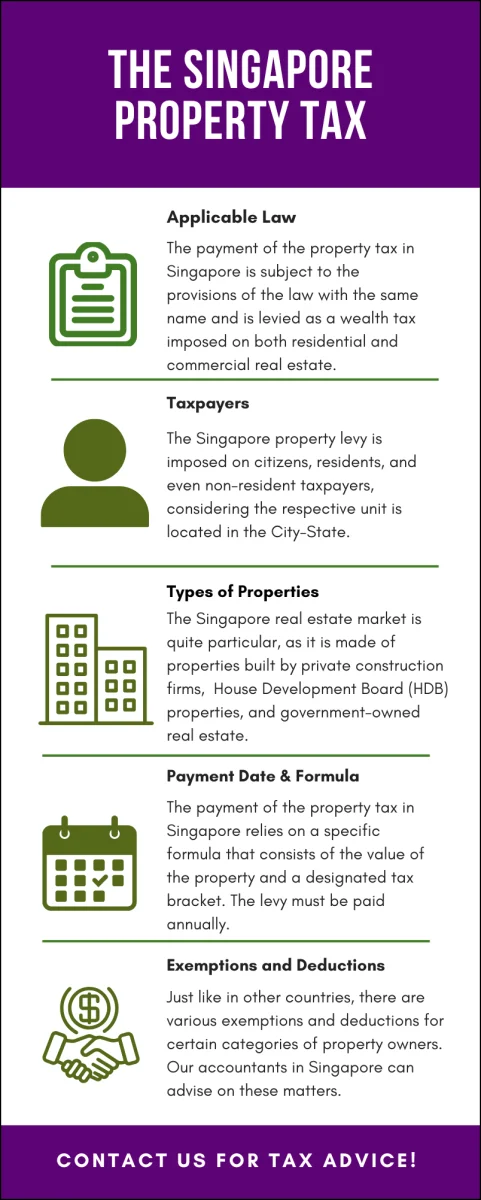
Here is also an infographic on this tax:
The property tax applied to non-residential buildings in Singapore
Not only natural persons own real estate in Singapore. As such, properties owned by companies or other entities must also pay the same levy. Commercial and industrial buildings are subject to the property tax in Singapore at a 10% rate of the annual value. The same applies to land plots.
If you want to open a company in the City-State and need accounting services, our specialists are at your disposal. You can rely on us for support with the payroll in Singapore. Also, our audit firm in Singapore can help with this important fiscal aspect.
The Singapore tax applicable to HDB property owners
The property tax in Singapore applies based on the type of real estate owned by a person. One of them refers to properties developed and sold by the Housing & Development Board (HDB) in the City-State. They also benefit from special tax regulations. Specifically, owners will pay a lower levy on flats and houses built by the HDB.
It is important to note that the lower tax applies to owner-occupied properties only. The difference between private-developed and HDB real estate consists of the annual value (AV), which favors the second category of owners. The first SGD 12,000 of the AV is taxed at 0%, while for the remaining value, progressive owner-occupier rates from 4% up to 32% apply.
The IRAS assesses the value of these properties based on the average rental prices in a calendar year.
Our accountants in Singapore can offer more information on the taxation of HDB house owners.
The Singapore property tax on real estate used as home offices
It is quite common for some Singapore citizens or residents to work from home, so they use their own properties as office space. The IRAS will usually tax such properties as residential-use real estate. However, there are cases in which exemptions apply. They can be obtained by filing for the Home Office Scheme with the HDB or the Urban Redevelopment Authority (URA).
The scheme applies to owners, tenants, and other occupiers to use any type of property as a home office and even hire a maximum of 2 non-resident employees to work from there. The main conditions to benefit from the scheme are:
- for the property to be used as a residence at all times;
- for the activities of the business to be carried out from the respective property alone.
In this case, the owner will pay the Singapore property tax at the owner-occupied rate instead of the commercial one.
Our accounting firm is at the service of clients with small businesses operating from home offices, including payroll support in Singapore.
Taxation of properties used for residential and commercial purposes
Another scenario that can be encountered in Singapore is that business owners use a larger property to live in, as well as premises for their commercial activities. The IRAS covers several scenarios, among which:
- the case where the property is used as a childcare center, which requires the payment of the property tax at a rate of 10% applicable to commercial buildings;
- the case where a part of the property is used as a place of residence and the other as a shop; in this situation, the IRAS will impose the tax on each part separately based on use.
Our local firm has several specialists on the team, so to diversify our services, you can also rely on us for audits in Singapore.
Property tax deductions in Singapore
Property owners in Singapore can benefit from certain tax rebates and deductions. Some of them are available for owners who cannot live in their homes because of repairs. Also, the government has also enabled interest relief for retired people who pay their property taxes in installments. However, they are subject to certain conditions among which:
- they are more than 65 years old;
- they must live in the respective homes;
- they have a maximum assessable income of SGD 34,000 per year.
Our accounting firm in Singapore can explain in detail how to apply for deductions for the property tax.
Here is also a video on this subject:
The property tax in Singapore is due every year on the 31st of January. If you have financial problems and cannot pay the property tax, you can get in touch with the IRAS to organize payment in installments. IRAS will afterward deliberate your request on an individual basis.
Our accountants in Singapore specialize in the different taxes in the city-state. Contact us for more details and assistance regarding the property tax in Singapore. They can also assist you in the process of registering your company for GST.